The Cambridge Programme and the Education System
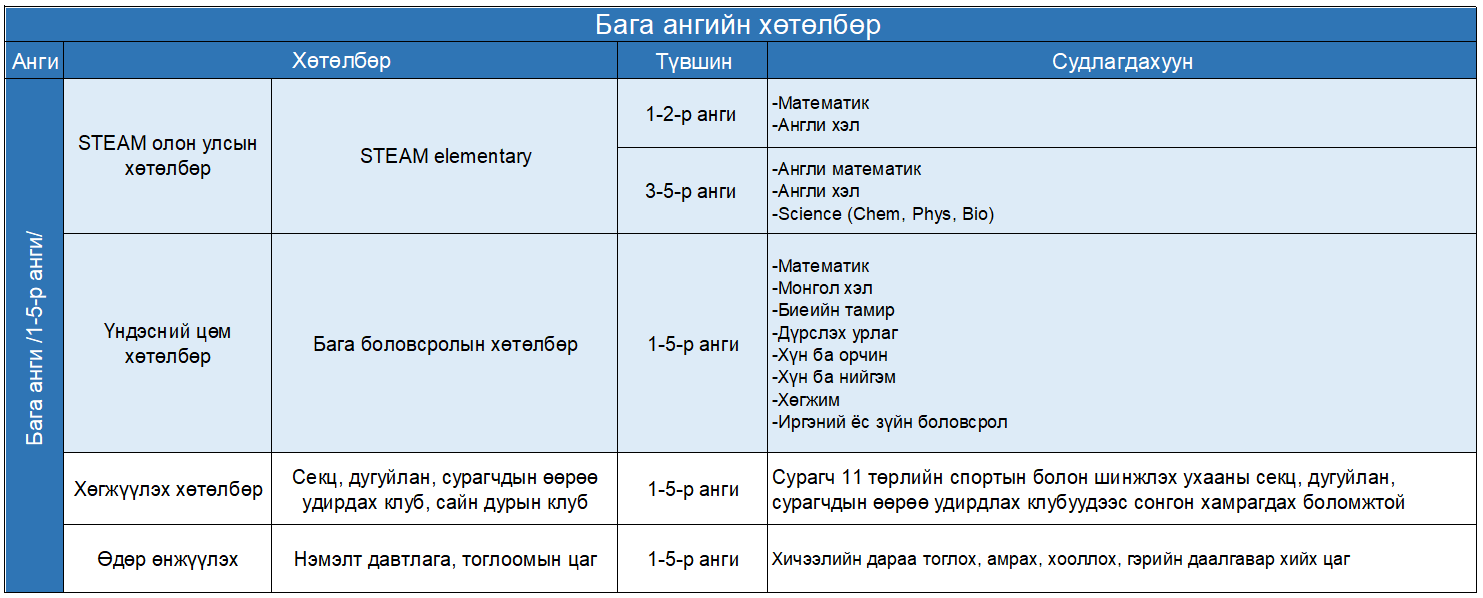
Primary-level curriculum
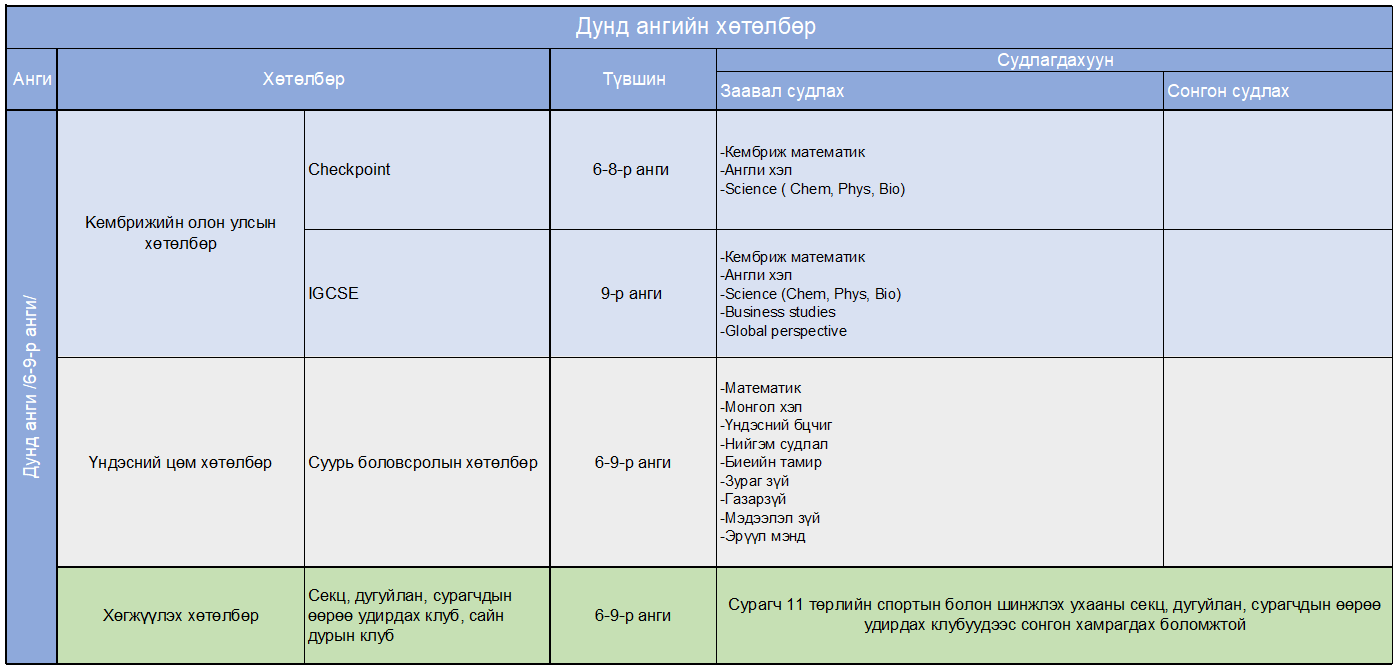
Middle-level curriculum
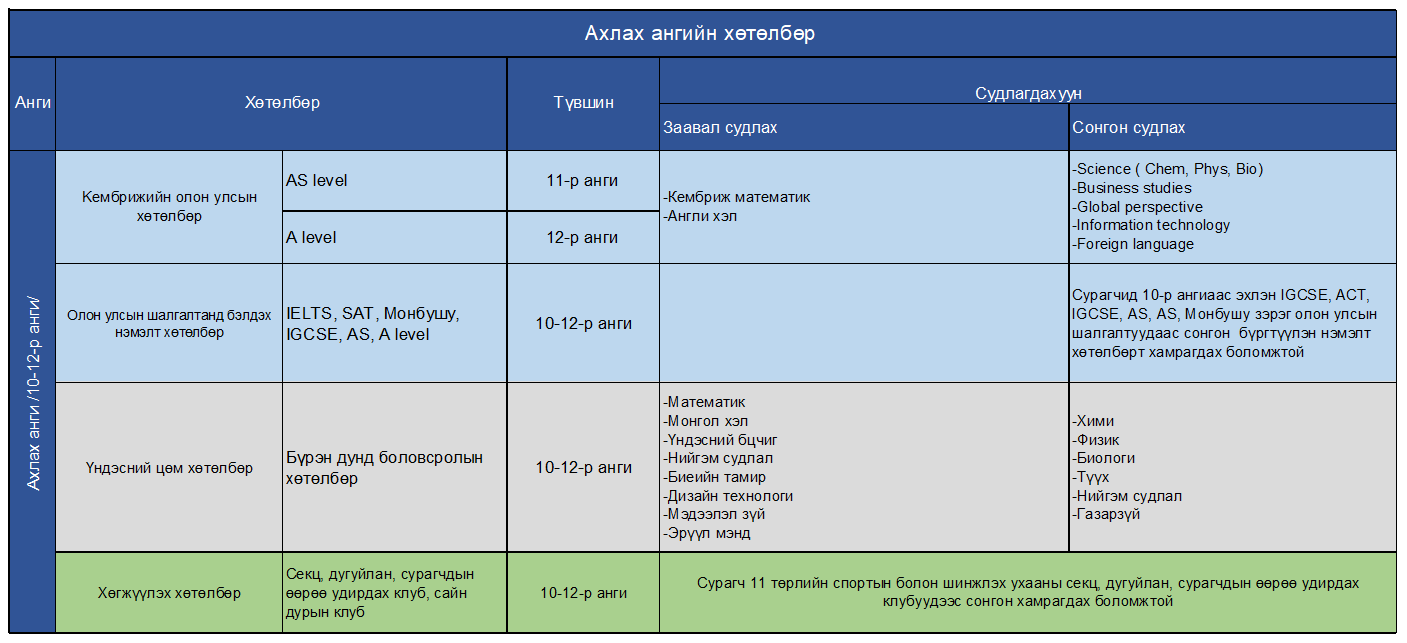
High-school curriculum
Darkhan Empathy School creates a welcoming educational environment and places special importance on its students’ upbringing, character development, and academic progress, valuing relationships built on mutual trust. Students study general academic subjects in accordance with the standard curriculum for basic and complete secondary education, and a team of highly qualified Mongolian and international teachers works with them — which has contributed to students’ academic success and to consistently winning top places at provincial, regional, national, and international-level olympiads in mathematics, physics, chemistry, biology, social studies, Mongolian language, history, and geography.
To give students an aesthetic education and an arts-and-culture education and to discover and develop their talents, the school runs clubs in fine-brush painting, chess, robotics, table tennis, basketball, handball, football, social welfare, public speaking, and poetry. By living in the dormitory on a set schedule, students develop strong skills in independent study, teamwork, doing homework, and review — which positively affects their academic success.
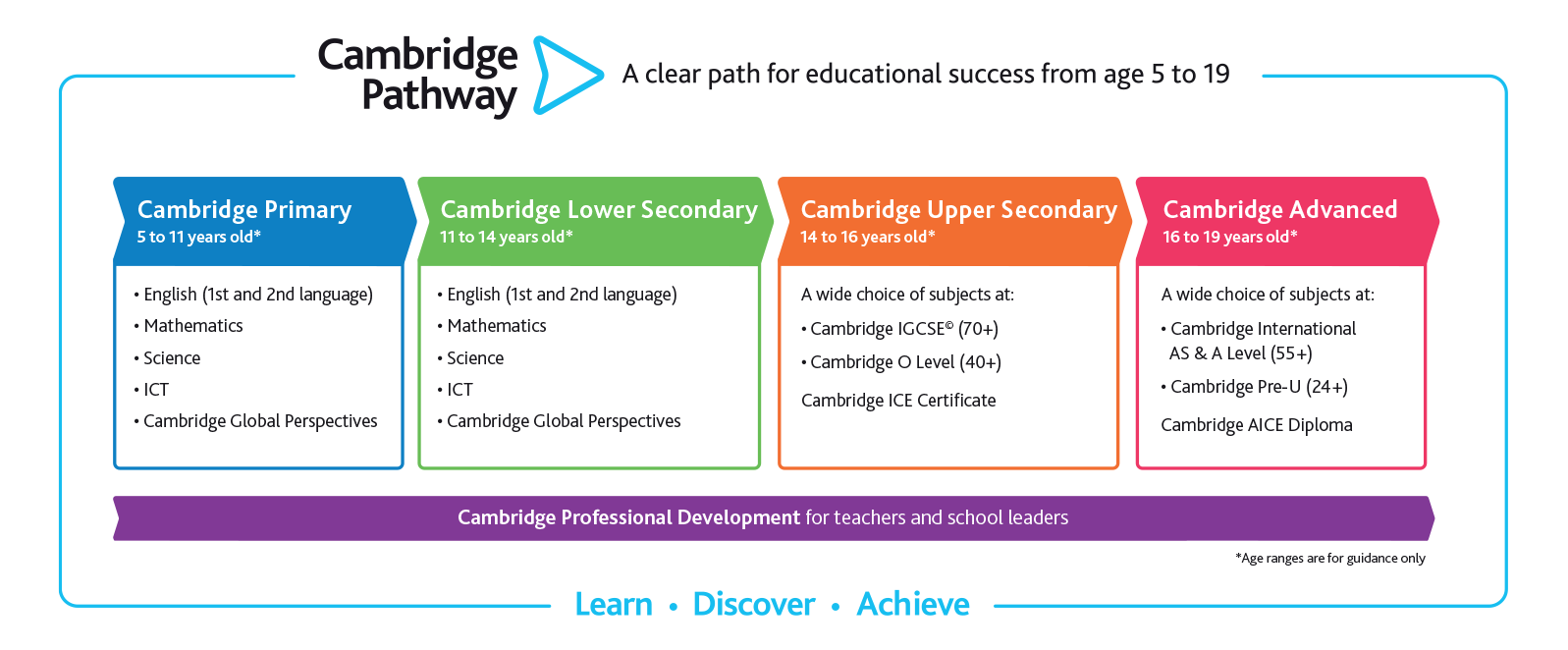
Darkhan Empathy School was the first in its region to begin implementing an international curriculum. In the 2024–2025 academic year, Darkhan-Empathy School, which offers the Cambridge international programme, has 42 core subject teachers — 35 Mongolian and 7 international (from Kazakhstan, Kyrgyzstan, Fiji, Tajikistan, and Pakistan) — successfully delivering high-quality instruction. A total of 560 students study in 23 classes from grades 6–12: 299 girls (53.3%) and 262 boys (46.7%). With the introduction of the Cambridge international programme, Mathematics, English, Science, Information Technology, Business Studies, and Global Perspectives are taught under the international programme in English and Mongolian, while Mongolian Language, Mongolian Script, Literature, Social Studies, Geography, Design and Technology, Technical Drawing, Fine Arts, History, Music, and Civic Ethics are taught in Mongolian within Mongolia’s core curriculum.
Each year, the school’s advisory council to the principal, the heads of the methodological units, subject teachers, and staff — including social workers, psychologists, and child-development specialists — provide reports and feedback that are incorporated into and implemented through that academic year’s activity plan. The curriculum plan is drawn up annually, monthly, and by term, with implementation and results assessed each month and term and reported to the principal’s advisory council and to the teachers’ council meetings. For current and pressing issues, special plans and activity guidelines are developed as needed, and internal monitoring and self-assessment of activities are carried out.
Implementation and results of Order A/511: There are five methodological units — English, Mongolian, Mathematics, Natural Sciences, and Humanities — that organize, lead, and oversee teaching and learning activities.
Programme to prepare for international exams
Exams we prepare for
International English
IGCSE · AS · A Level
Scholastic Assessment
Students who take and earn scores on the Cambridge international IGCSE, AS, and A-level exams, as well as IELTS and SAT, can have their scores recognized as equivalent to Mongolia’s national entrance-exam (EYESH) scores.